Some things are built for the moment.
Some become part of what follows.
Anvaya is rooted in the belief that meaningful progress is rarely created in isolation. It emerges through people, ideas, institutions, and the connections between them.
We create the conditions for those forces to come together, and then stay long enough that what they build can outlast its beginning, and eventually be owned entirely by someone else.
The person doing the hardest work deserves the best tools. Not the leftover ones.
No frontline worker should work blind
Every health worker, teacher and paralegal should have records, reminders and answers that hold up without a signal.
No one left out by language or ability
If a service exists, it should reach people in their own language, by voice, and in formats that work for disabled people.
It keeps working after we leave
Most donated tech stops working within two years. Whatever we build, you own outright: the code, the data and the training to run it yourselves.
Some of what we try will not work. When that happens we will say so publicly, explain why, and share what we learned so the next team doesn't repeat it.
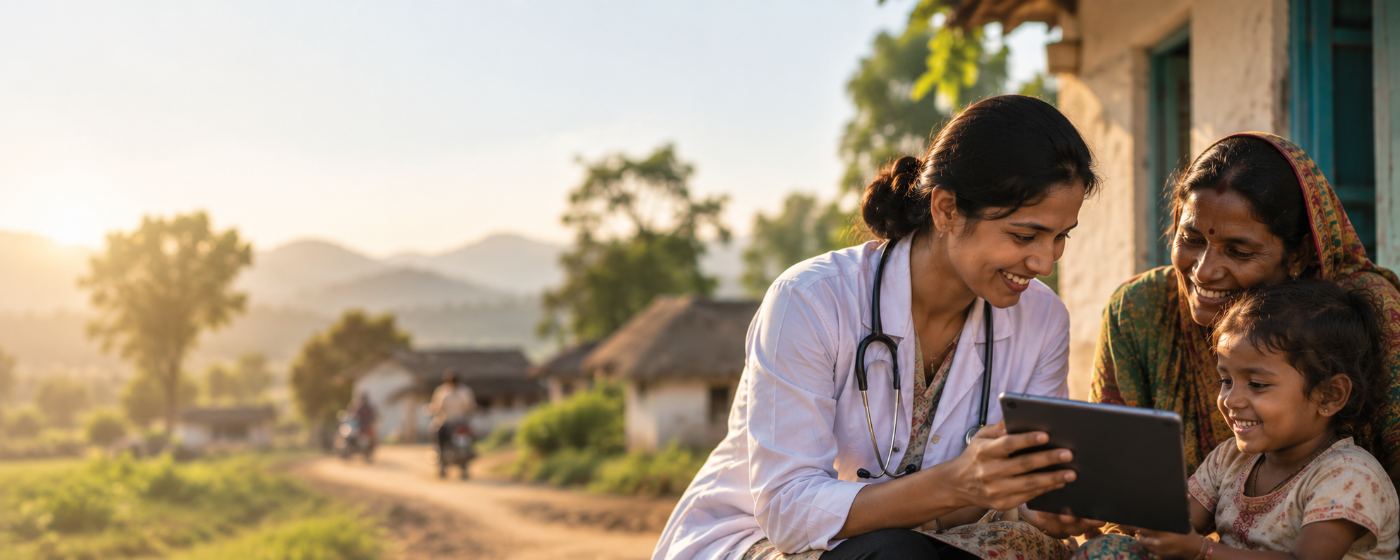
Three ordinary mornings, and why they are not ordinary yet.
No breakthrough needed. Just software nobody has built yet.
A blind girl opens the same chapter as her class, the same morning.
A mother returns for a follow-up. Her history is already there.
A farmer hears this week’s one task, in his own language, in the field.
Why this can be free, and stay free.
Anvaya is not a grant programme and does not fundraise.
That is the honest reason there is no licence fee. Nothing here depends on a philanthropic round closing, so nothing here disappears when one does not.
The only line we cannot cover is the one on the ground. It is also the one a CSR budget funds most easily.

Continuity
What is created should have a life beyond its beginning, and a maintainer after us.
Possibility
Every meaningful change begins as somebody's idea, usually somebody close to the problem.
Growth
Ideas become meaningful when they evolve, take root and survive their second year.
Togetherness
Lasting work is built through people and shared purpose, never handed down.
From an idea to something enduring.
Four stages, the first twelve weeks. Pick one to see what you have in hand at the end of it.
{{ psTitle }}
{{ psBody }}
Saying no is part of the method.
A wrong yes costs a year nobody gets back. In these five cases we say so in the first week.
Nobody owns it
Without a technical owner inside the organisation, the work ends at handover.
The bottleneck is not software
Funding, staffing and permission do not yield to engineering.
Scoring people
No risk scores, no prediction about who deserves help.
Surveillance by another name
Monitoring of staff or communities, however it is framed.
A pilot for a report
Work designed to be shown rather than used.
And what we always say yes to
A bottleneck someone has lived with long enough to describe in one sentence.
What we leave behind matters.
The work you begin this year can still be running long after you have moved on. Very few things offer that. This one does.
See what this looks like in practice →